Pixelated Lies
Product Design
UX/UI Design
UX Research
Project Duration
Team
Tools
Role
1 Month (Mar-Apr 2025)
Kimiya Fani, Soyoung Jeong, Nicole Yan
Figma, Adobe Illustrator
Product Designer
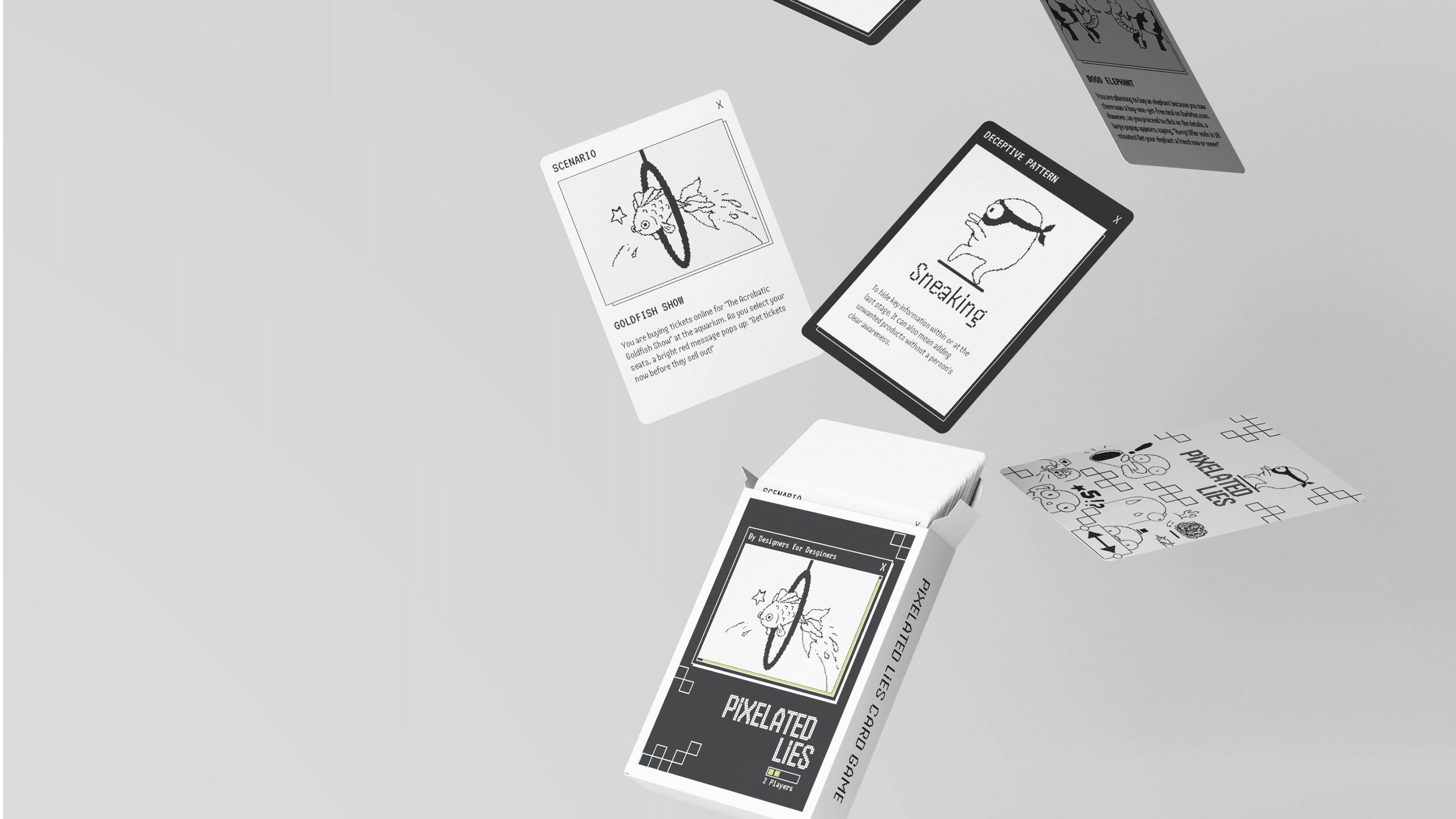
A multi-player card game that uncovers deceptive design patterns in everyday products and services. Through real-world-inspired scenarios, players explore deceptive design patterns in a fun and thought-provoking way, sparking meaningful conversations and new perspectives.
This was a course project for the course DESN 2113: History and Culture of Interaction Design
Pixelated Lies
Product Design
UX/UI Design
UX Research
Project Duration
Team
Tools
Role
1 Month (Mar-Apr 2025)
Kimiya Fani, Soyoung Jeong, Nicole Yan
Figma, Adobe Illustrator
Product Designer
A multi-player card game that uncovers deceptive design patterns in everyday products and services. Through real-world-inspired scenarios, players explore deceptive design patterns in a fun and thought-provoking way, sparking meaningful conversations and new perspectives.
This was a course project for the course DESN 2113: History and Culture of Interaction Design
Pixelated Lies
Product Design
UX/UI Design
UX Research
Project Duration
Team
Tools
Role
1 Month (Mar-Apr 2025)
Kimiya Fani, Soyoung Jeong, Nicole Yan
Figma, Adobe Illustrator
Product Designer
A multi-player card game that uncovers deceptive design patterns in everyday products and services. Through real-world-inspired scenarios, players explore deceptive design patterns in a fun and thought-provoking way, sparking meaningful conversations and new perspectives.
This was a course project for the course DESN 2113: History and Culture of Interaction Design
OVERVIEW
OVERVIEW
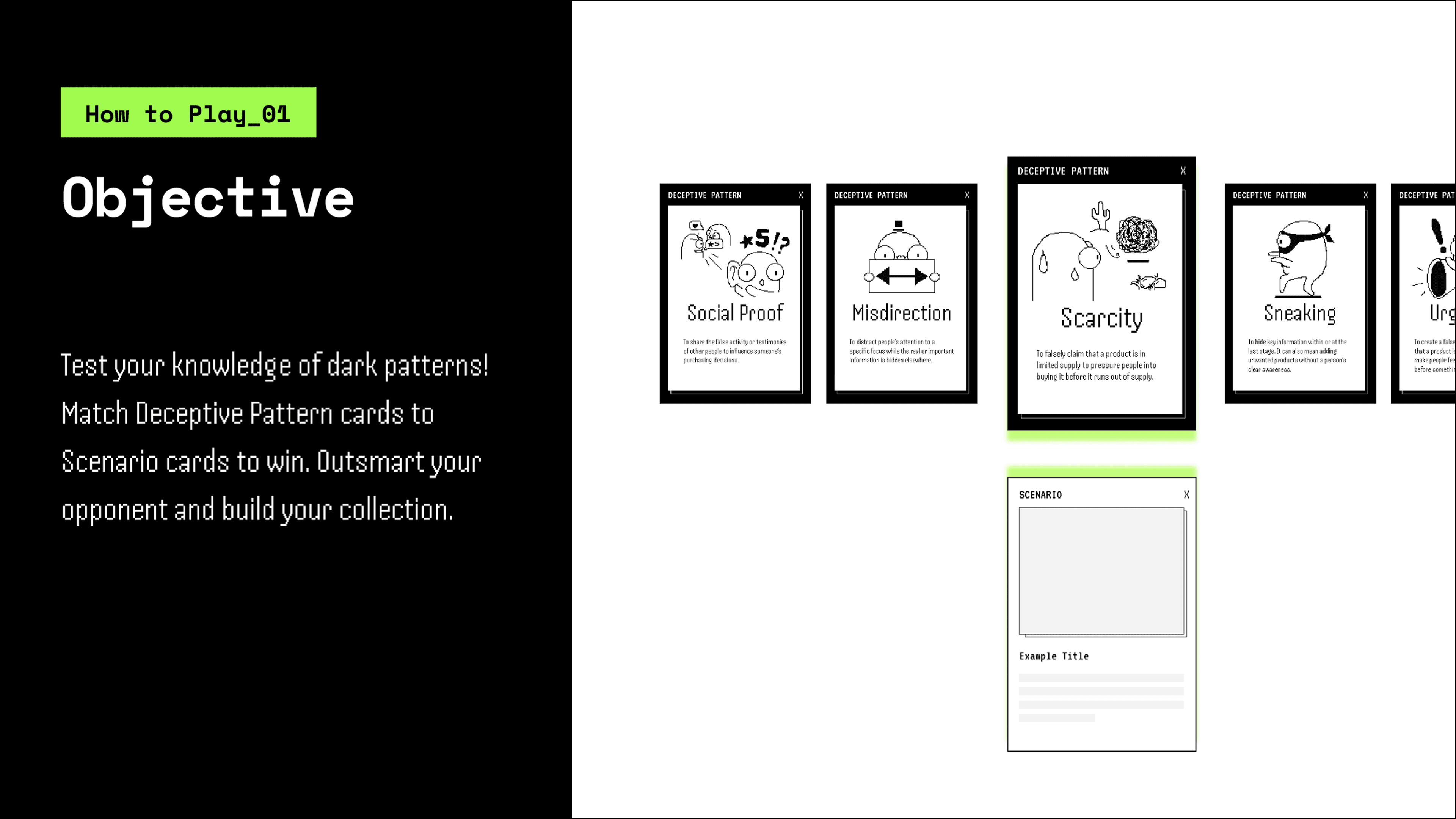
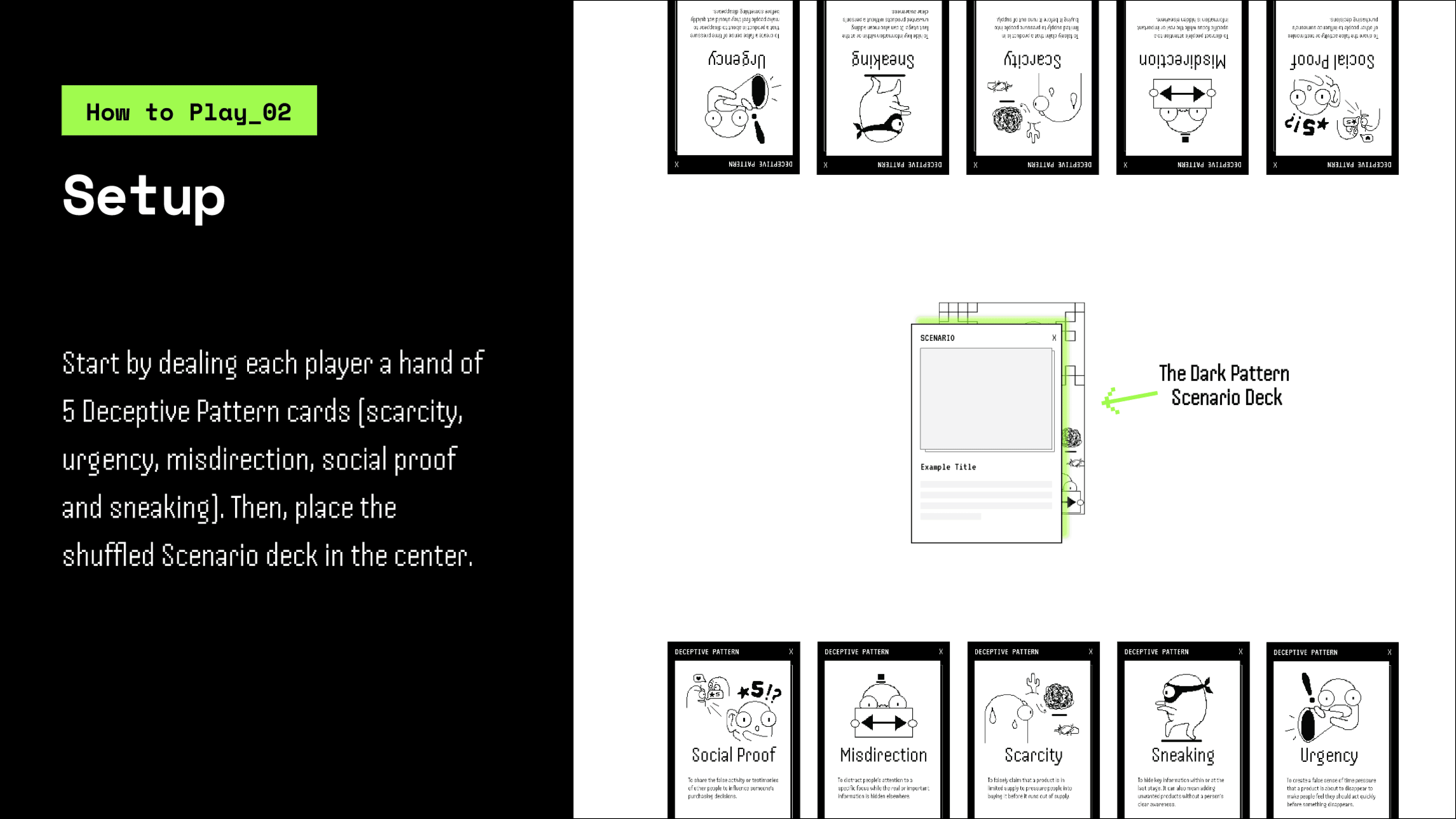
Pixelated Lies is a 2-player toolkit about the deceptive design patterns we encounter in our everyday lives. By recognizing and understanding unhandled tactics such as scarcity, urgency, misdirection, social proof and sneaking, players will learn how these design choices influence our decision-making.
The game uses hypothetical, real-life examples to illustrate common dark patterns to encourage awareness and conversation to come up with strategies to avoid being manipulated by them.
Pixelated Lies is a 2-player toolkit about the deceptive design patterns we encounter in our everyday lives. By recognizing and understanding unhandled tactics such as scarcity, urgency, misdirection, social proof and sneaking, players will learn how these design choices influence our decision-making.
The game uses hypothetical, real-life examples to illustrate common dark patterns to encourage awareness and conversation to come up with strategies to avoid being manipulated by them.
Pixelated Lies is a 2-player toolkit about the deceptive design patterns we encounter in our everyday lives. By recognizing and understanding unhandled tactics such as scarcity, urgency, misdirection, social proof and sneaking, players will learn how these design choices influence our decision-making.
The game uses hypothetical, real-life examples to illustrate common dark patterns to encourage awareness and conversation to come up with strategies to avoid being manipulated by them.
The Problem
The Problem
Deceptive patterns promote business outcomes at the users’ expense. They influence users' decisions in ways that are often overlooked, as they can go unnoticed even by well-intentioned designers, leading to a breach of user trust and a negative impact on the brand’s reputation.
This lack of awareness and empathy perpetuates harmful practices that can frustrate users and pose a risk to long-term business goals and customer loyalty.
Deceptive patterns promote business outcomes at the users’ expense. They influence users' decisions in ways that are often overlooked, as they can go unnoticed even by well-intentioned designers, leading to a breach of user trust and a negative impact on the brand’s reputation.
This lack of awareness and empathy perpetuates harmful practices that can frustrate users and pose a risk to long-term business goals and customer loyalty.
Project Objectives
Project Objectives
The game aims to help both designers and users make more informed decisions—whether they are designing products for others or using those products themselves.
The game aims to help both designers and users make more informed decisions—whether they are designing products for others or using those products themselves.
My Role
My Role
Conducted deep-dive research into five specific dark pattern categories, synthesizing complex deceptive tactics into relatable user scenarios.
Led the visual direction, including custom character design, packaging for the physical toolkit, and card deck design.
Led the end-to-end UI/UX design for the companion information site, moving from low-fidelity wireframes to a fully responsive interface.
Facilitated usability testing to ensure the toolkit was educational, accessible, and engaging for our target audience.
Conducted deep-dive research into five specific dark pattern categories, synthesizing complex deceptive tactics into relatable user scenarios.
Led the visual direction, including custom character design, packaging for the physical toolkit, and card deck design.
Led the end-to-end UI/UX design for the companion information site, moving from low-fidelity wireframes to a fully responsive interface.
Facilitated usability testing to ensure the toolkit was educational, accessible, and engaging for our target audience.
RESEARCH
RESEARCH
We began by asking ourselvess…
How can we, as designers, recognize these subtle tricks and protect users?
How can we, as designers, recognize these subtle tricks and protect users?
Awareness is the first line of defense against digital manipulation. We began our research phase by deconstructing the anatomy of dark patterns, seeking to understand how interfaces can be weaponized against user intent.
By centering our study on five key categories—Scarcity, Urgency, Misdirection, Social Proof, and Sneaking—we established a baseline for ethical critique. We explored everyday digital landscapes to see exactly where and how these deceptive patterns are hidden in plain sight.
Awareness is the first line of defense against digital manipulation. We began our research phase by deconstructing the anatomy of dark patterns, seeking to understand how interfaces can be weaponized against user intent.
By centering our study on five key categories—Scarcity, Urgency, Misdirection, Social Proof, and Sneaking—we established a baseline for ethical critique. We explored everyday digital landscapes to see exactly where and how these deceptive patterns are hidden in plain sight.
Problem Statement
Problem Statement
How might we create an accessible and engaging tool that can helps designers and stakeholders recognize and reflect on deceptive patterns in order to achieve more human-centred experiences?
How might we create an accessible and engaging tool that can helps designers and stakeholders recognize and reflect on deceptive patterns in order to achieve more human-centred experiences?
Research Goals
Research Goals
To guide us through our user research, we defined the following goals:
To guide us through our user research, we defined the following goals:
Understand & Identify
Understand how deceptive pattern are defined and treated in everyday digital products and identify the harmful impact on users.
Understand & Identify
Understand how deceptive pattern are defined and treated in everyday digital products and identify the harmful impact on users.
Categorize
Sort the deceptive patterns examples into five categories: scarcity, urgency, misdirection, social proof and sneaking
Categorize
Sort the deceptive patterns examples into five categories: scarcity, urgency, misdirection, social proof and sneaking
Best Practices
Define best design practices, what to watch for, how to avoid common deceptive patterns and how to spot them. Think about possible ethical alternatives and redesign solutions.
Best Practices
Define best design practices, what to watch for, how to avoid common deceptive patterns and how to spot them. Think about possible ethical alternatives and redesign solutions.
Methodology
Methodology
We reviewed academic articles and design pattern libraries to understand how these are defined, categorized, and critiqued.
We reviewed academic articles and design pattern libraries to understand how these are defined, categorized, and critiqued.
The research process of this project involved scoping the different existing deceptive patterns and analyzing their application in various contexts, often including service websites, e-commerce, and subscription models.
The research process of this project involved scoping the different existing deceptive patterns and analyzing their application in various contexts, often including service websites, e-commerce, and subscription models.
Why this method?
Why this method?
By examining real-life examples and experiencing these tactics ourselves, we are grounding this project in research that will make our solution more relatable and understandable on a personal level.
This approach will make the learning process not only more accessible and foster empathy through universal experiences but also evidence-based through academic foundation.
By walking-in to community centres we have access to talk with Baby Boomers who participate in recreational activities and Admins who provide and assist them with the sign-up process.
Many Baby Boomers may be more comfortable with face-to-face interaction than with an online survey or an email request. An in-person approach, even a brief one, can feel more personal, and trustworthy.
Sending out E-mails allowed us to have a larger scalability and reach to Administrators giving participants more time to provide more detailed and reflective answers.
By walking-in to community centres we have access to talk with Baby Boomers who participate in recreational activities and Admins who provide and assist them with the sign-up process.
Many Baby Boomers may be more comfortable with face-to-face interaction than with an online survey or an email request. An in-person approach, even a brief one, can feel more personal, and trustworthy.
Sending out E-mails allowed us to have a larger scalability and reach to Administrators giving participants more time to provide more detailed and reflective answers.
DESIGN SOLUTION
DESIGN SOLUTION
Target User
Target User
Empathize | Who are our users?
Empathize | Who are our users?
Primary: Designers
Primary: Designers
The people who build products. UX Designers, Product Designers, Researchers and students.
The people who build products. UX Designers, Product Designers, Researchers and students.
Why this demographic?
Why this demographic?
These professionals are directly involved in creating digital products, as they create user interfaces and flows.
Susceptible to using deceptive patterns—sometimes intentionally due to business pressure, sometimes unintentionally due to lack of awareness.
These professionals are directly involved in creating digital products, as they create user interfaces and flows.
Susceptible to using deceptive patterns—sometimes intentionally due to business pressure, sometimes unintentionally due to lack of awareness.
Secondary User: Recreational Center Administrators
The people who enable products. Stakeholders such as Project/Product managers, clients and executives.
Secondary User: Recreational Center Administrators
The people who enable products. Stakeholders such as Project/Product managers, clients and executives.
Why this demographic?
Why this demographic?
They hold the power in how products are built and experienced.
They set business goals, budgets, and timelines which often pressure teams into prioritizing short-term gains over user well-being.
They hold the power in how products are built and experienced.
They set business goals, budgets, and timelines which often pressure teams into prioritizing short-term gains over user well-being.
Personas
Personas
Who do we want to build for?
Who do we want to build for?
Ideation
Ideation
Ideate | How can we help our users?
Ideate | How can we help our users?
As a team, we began defining our own design philosophy to guide us through our own design and to ensure our work is both ethical and user-centred.
As a team, we began defining our own design philosophy to guide us through our own design and to ensure our work is both ethical and user-centred.
Our Values
Our Values
Advocate
Advocate
Aim to become better designers who leave a positive mark on society. Many issues are overlooked because they are too “specific” or “small”, so we can act as advocates for those who don’t have voices and issues are often overlooked or dismissed
Aim to become better designers who leave a positive mark on society. Many issues are overlooked because they are too “specific” or “small”, so we can act as advocates for those who don’t have voices and issues are often overlooked or dismissed
Responsibility & Empathy
Responsibility & Empathy
Design is about the people. It is about creating a sense of community and fostering compassion throughout the user’s experience. As designers, it is important to be transparent and honest to maintain our values/ethics.
Design is about the people. It is about creating a sense of community and fostering compassion throughout the user’s experience. As designers, it is important to be transparent and honest to maintain our values/ethics.
Worldly Experience
Worldly Experience
Be aware and conscious of world events, issues, news, and history to make morally right decisions
Be aware and conscious of world events, issues, news, and history to make morally right decisions
Storytelling
Storytelling
To provide a space and become an effective communicator to help share or spread ideas, stories, and messages to make people feel seen and heard.
To provide a space and become an effective communicator to help share or spread ideas, stories, and messages to make people feel seen and heard.
Key Words
We defined key words of what our solution should reflect.
We defined key words of what our solution should reflect.
To use GAMIFICATION as a way to transform learning into play, by converting deceptive patterns examples into a FUN and ENGAGING experience. By grounding the game in real-world scenarios, we empathize with users through the universal experience of frustration and confusion when deceptive patterns are involved in product design.
The game will foster TEAMWORK and spark insightful conversations, that leads you to IMPART WITH KNOWLEDGE with every play. Identifying and discussing deceptive patterns can be challenging. The game makes this process REWARDING by giving users a sense of accomplishment when they successfully spot and debate these hidden issues.
To use GAMIFICATION as a way to transform learning into play, by converting deceptive patterns examples into a FUN and ENGAGING experience. By grounding the game in real-world scenarios, we empathize with users through the universal experience of frustration and confusion when deceptive patterns are involved in product design.
The game will foster TEAMWORK and spark insightful conversations, that leads you to IMPART WITH KNOWLEDGE with every play. Identifying and discussing deceptive patterns can be challenging. The game makes this process REWARDING by giving users a sense of accomplishment when they successfully spot and debate these hidden issues.
Game Ideation Process
We aimed to create a physical, tactile experience that would spark interaction and discussion. To achieve this we:
We aimed to create a physical, tactile experience that would spark interaction and discussion. To achieve this we:
Researched existing card games for mechanics, drawing inspiration from “Cards Against Humanity” and classic matching games.
Brainstormed multiple gameplay methods, testing how they could best teach and engage players.
Researched existing card games for mechanics, drawing inspiration from “Cards Against Humanity” and classic matching games.
Brainstormed multiple gameplay methods, testing how they could best teach and engage players.
After compiling all of our findings, we narrowed down ideas to one idea that we found potential to expand and refined on.
After compiling all of our findings, we narrowed down ideas to one idea that we found potential to expand and refined on.
Matching Card Game / Toolkit
We decided to go with the matching cards gameplay style because it created a simple, intuitive way for players to connect dark pattern cards with real-world scenario cards.
This format encouraged quick recognition, discussion, and reflection, while staying fun and
easy to grasp.
We decided to go with the matching cards gameplay style because it created a simple, intuitive way for players to connect dark pattern cards with real-world scenario cards.
This format encouraged quick recognition, discussion, and reflection, while staying fun and
easy to grasp.
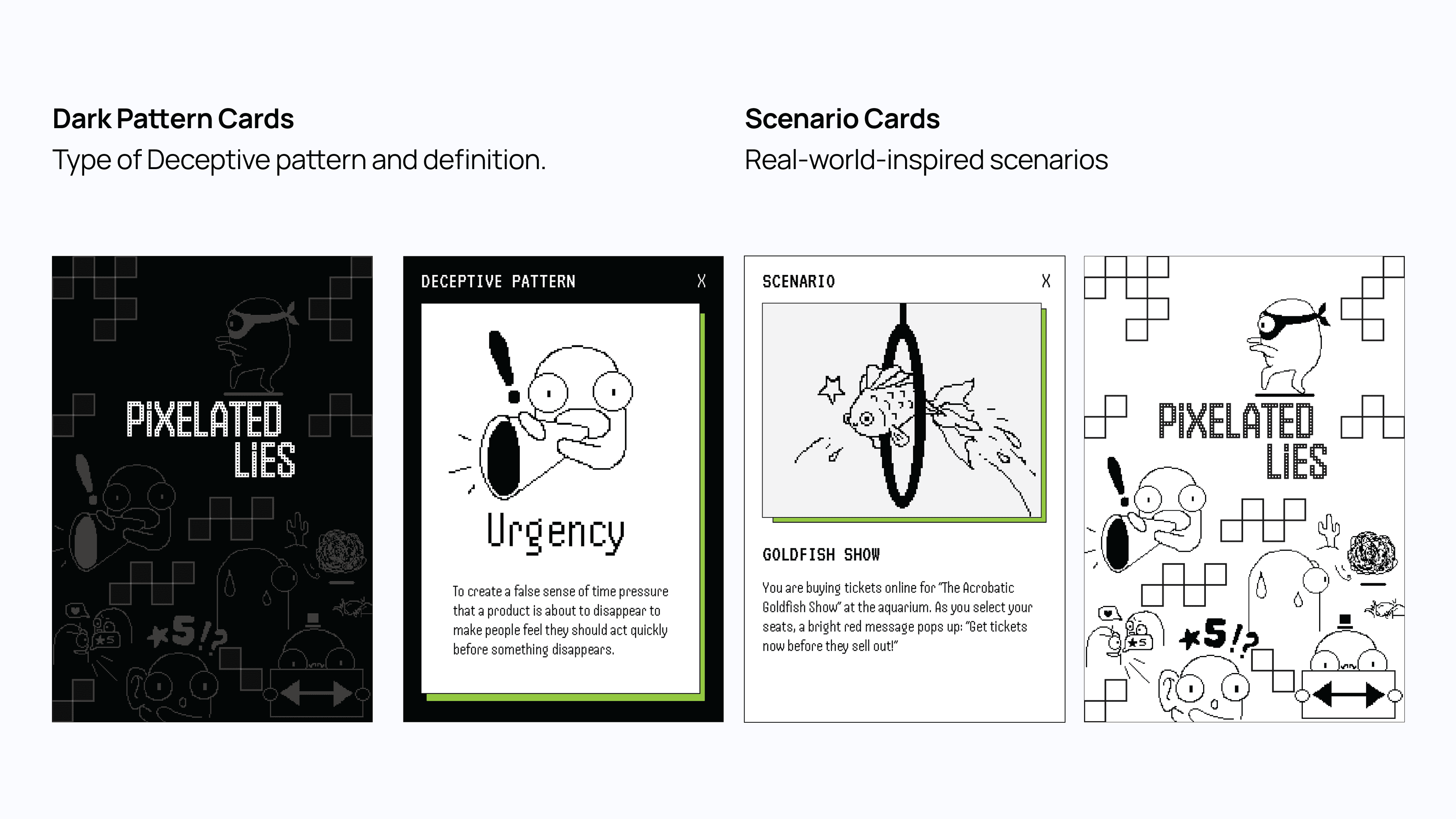
2 card sets
Dark pattern type (ex. Urgency)
Dark pattern example (ex. Hurry! Only 10 items left in stock. Order now before it's gone!)
Player needs to match the dark pattern to example to the example.
Prompt discussion about possible solution (ex. reword toLow in stock. We recommend ordering soon to ensure availability.")
2 card sets
Dark pattern type (ex. Urgency)
Dark pattern example (ex. Hurry! Only 10 items left in stock. Order now before it's gone!)
Player needs to match the dark pattern to example to the example.
Prompt discussion about possible solution (ex. reword toLow in stock. We recommend ordering soon to ensure availability.")
Wireframes
Wireframes
High-Fidelity Prototype
High-Fidelity Prototype
After solidifying our idea, we began designing the main elements of our toolkit.
After solidifying our idea, we began designing the main elements of our toolkit.
Usability Testing
Usability Testing
Can the solution we are building be used?
After play-testing among ourselves, we developed a manual to guide players through the setup and gameplay. The manual served as both an instructional tool that provides clear steps and quick references to ensure accessibility for players with varying familiarity with card games.
After play-testing among ourselves, we developed a manual to guide players through the setup and gameplay. The manual served as both an instructional tool that provides clear steps and quick references to ensure accessibility for players with varying familiarity with card games.
Testing Plan
Testing Plan
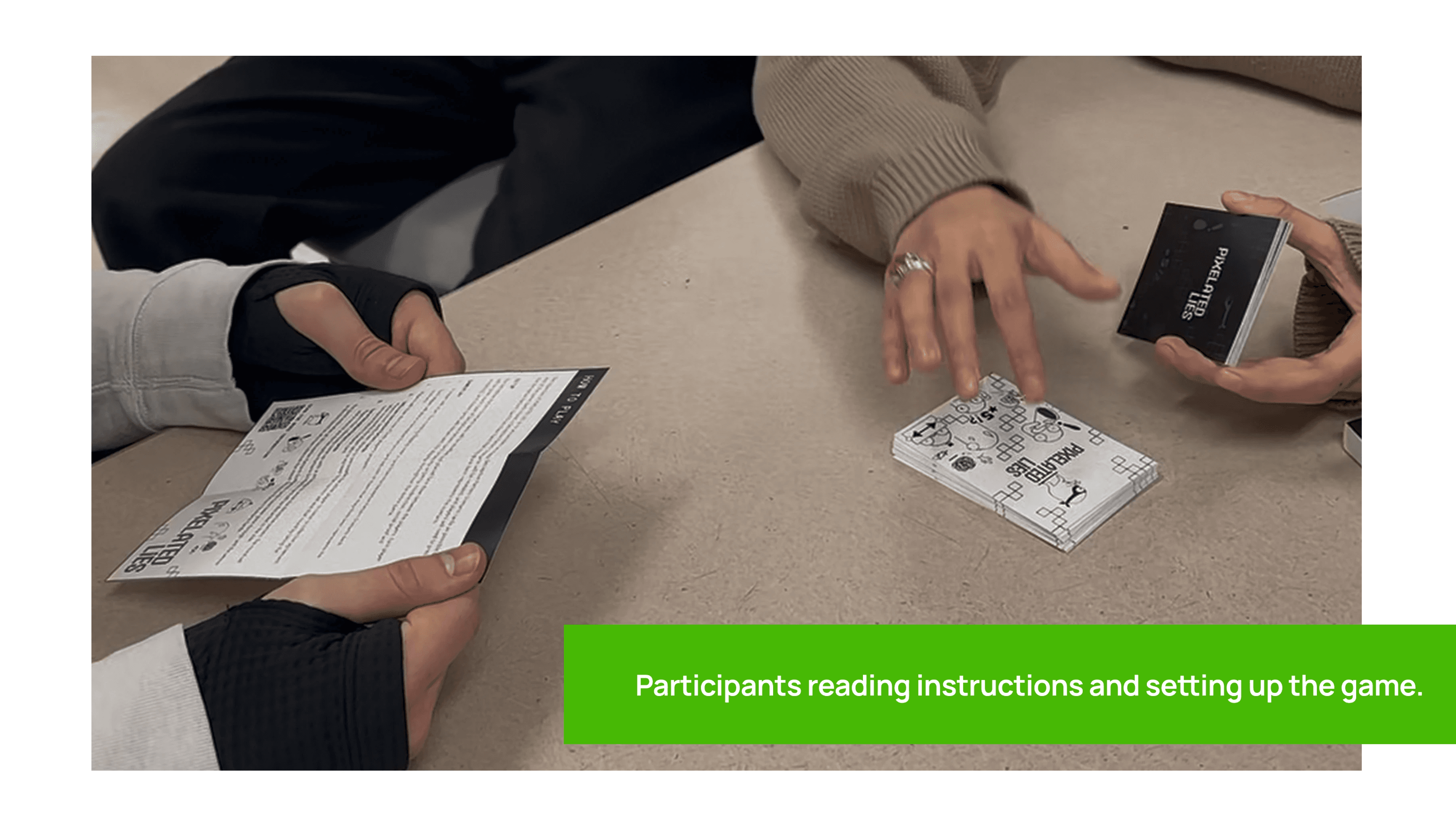
This prototype was user-tested in person with two Design students from York University.
Task Under Test & Goal
Participants were given the full deck of cards without detailed instructions.
The goal was to observe how they approached the game, how intuitive the design of the gameplay was, and how users interpreted the instructions.
Throughout the play-testing, we began modifying the rules, refining card interactions, and evolving the game structure to strike the right balance between learning and enjoyment.
This prototype was user-tested in person with two Design students from York University.
Task Under Test & Goal
Participants were given the full deck of cards without detailed instructions.
The goal was to observe how they approached the game, how intuitive the design of the gameplay was, and how users interpreted the instructions.
Throughout the play-testing, we began modifying the rules, refining card interactions, and evolving the game structure to strike the right balance between learning and enjoyment.
Testing Insights
Testing Insights
How did it go?
After testing, users mentioned they enjoyed the concept and visualization of the toolkit; however, they encountered pain points during the setup and gameplay.
After testing, users mentioned they enjoyed the concept and visualization of the toolkit; however, they encountered pain points during the setup and gameplay.
Pain Points
Pain Points
The following key insights were identified about the overall prototype’s design and navigation process:
The following key insights were identified about the overall prototype’s design and navigation process:
Unclear Instructions
Unclear Instructions
Participants were confused about how to set up and start the game, along with what to do with the cards when certain agreements and disagreements were reached.
Participants were confused about how to set up and start the game, along with what to do with the cards when certain agreements and disagreements were reached.
Uncertain Gameplay
Uncertain Gameplay
Sort the deceptive patterns examples into five categories: scarcity, urgency, misdirection, social proof and sneaking
Sort the deceptive patterns examples into five categories: scarcity, urgency, misdirection, social proof and sneaking
What does this mean?
What does this mean?
Translating discovered pain points into opportunities.
Translating discovered pain points into opportunities.
Adding Visuals & Refining Wording
Adding Visuals & Refining Wording
User need a quicker and intuitive way to start the game without having to read through long texts.
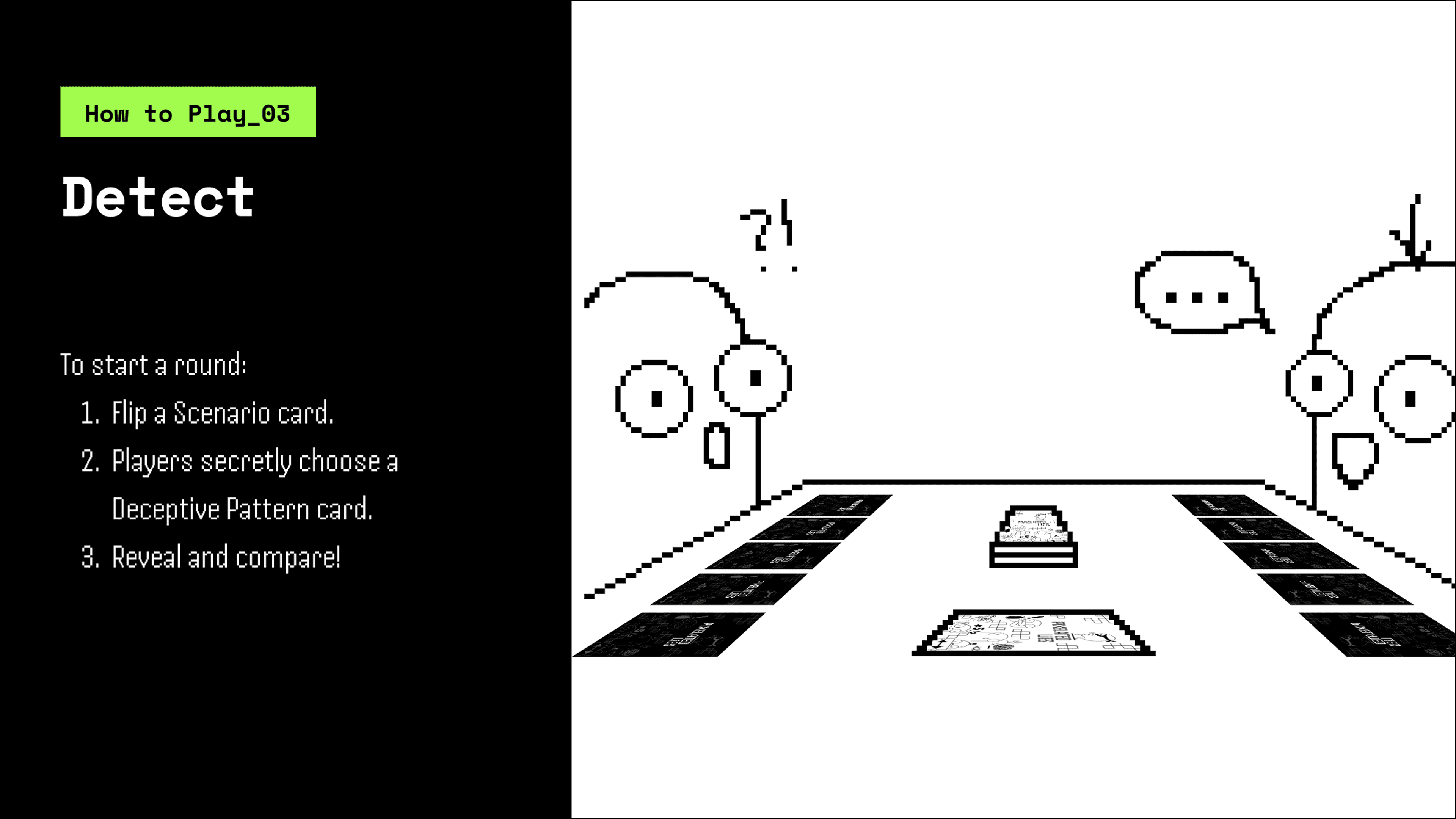
Include illustrations in the manual and on setup pages to make it quicker for players to grasp how to arrange the deck and begin gameplay.
Break down complex steps into digestible parts.
Integrating visual cues in the manual to indicate what a player should do with a card after a specific action
User need a quicker and intuitive way to start the game without having to read through long texts.
Include illustrations in the manual and on setup pages to make it quicker for players to grasp how to arrange the deck and begin gameplay.
Break down complex steps into digestible parts.
Integrating visual cues in the manual to indicate what a player should do with a card after a specific action
Guided Example
Guided Example
User need a guided demonstration to follow and reassure themselves they are on the right track.
Add an an example round into the game’s manual.
Create a short demo video that visually explains the gameplay.
User need a guided demonstration to follow and reassure themselves they are on the right track.
Add an an example round into the game’s manual.
Create a short demo video that visually explains the gameplay.
As a team, we paid close attention to their initial interactions, moments of confusion or hesitation, and how they naturally interpreted the rules.
This open-ended approach allowed us to see how intuitive the design was and identify areas where the instructions, card mechanics, or flow needed refinement.
We carried these testing insights and recommendations to our final design.
As a team, we paid close attention to their initial interactions, moments of confusion or hesitation, and how they naturally interpreted the rules.
This open-ended approach allowed us to see how intuitive the design was and identify areas where the instructions, card mechanics, or flow needed refinement.
We carried these testing insights and recommendations to our final design.
Final Solution
Final Solution
Introducing..
Introducing..
Pixelated Lies a design toolkit designed to encourage designers to think critically about deceptive patterns and learn to spot them.
Pixelated Lies a design toolkit designed to encourage designers to think critically about deceptive patterns and learn to spot them.
Pixelated Lies a design toolkit designed to encourage designers to think critically about deceptive patterns and learn to spot them.
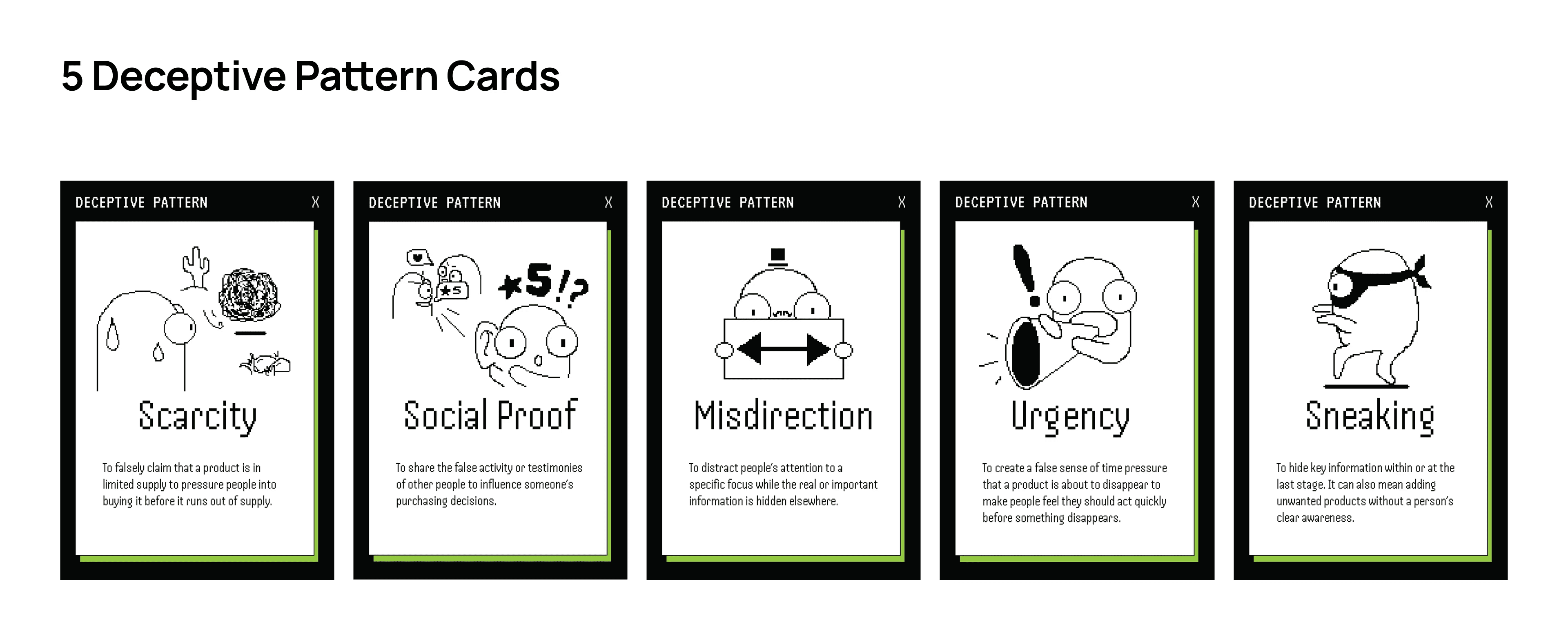
Learn how to spot Scarcity, Social Proof, Misdirection, Urgency, and Sneaking.
Learn how to spot Scarcity, Social Proof, Misdirection, Urgency, and Sneaking.
Learn how to spot Scarcity, Social Proof, Misdirection, Urgency, and Sneaking.
Engage and spark critical conversation with in-game scenarios inspired by real-life cases of deceptive design patterns with a creative twist.
Engage and spark critical conversation with in-game scenarios inspired by real-life cases of deceptive design patterns with a creative twist.
As advocates, designers can educate others about the negative implications of deceptive patterns and how they can affect people, holding employers of these patterns accountable.
As advocates, designers can educate others about the negative implications of deceptive patterns and how they can affect people, holding employers of these patterns accountable.
As advocates, designers can educate others about the negative implications of deceptive patterns and how they can affect people, holding employers of these patterns accountable.
Individuals involved in the design process, including clients and corporate executives, are also encouraged to participate and empathize with users of their products and services.
Individuals involved in the design process, including clients and corporate executives, are also encouraged to participate and empathize with users of their products and services.
Individuals involved in the design process, including clients and corporate executives, are also encouraged to participate and empathize with users of their products and services.
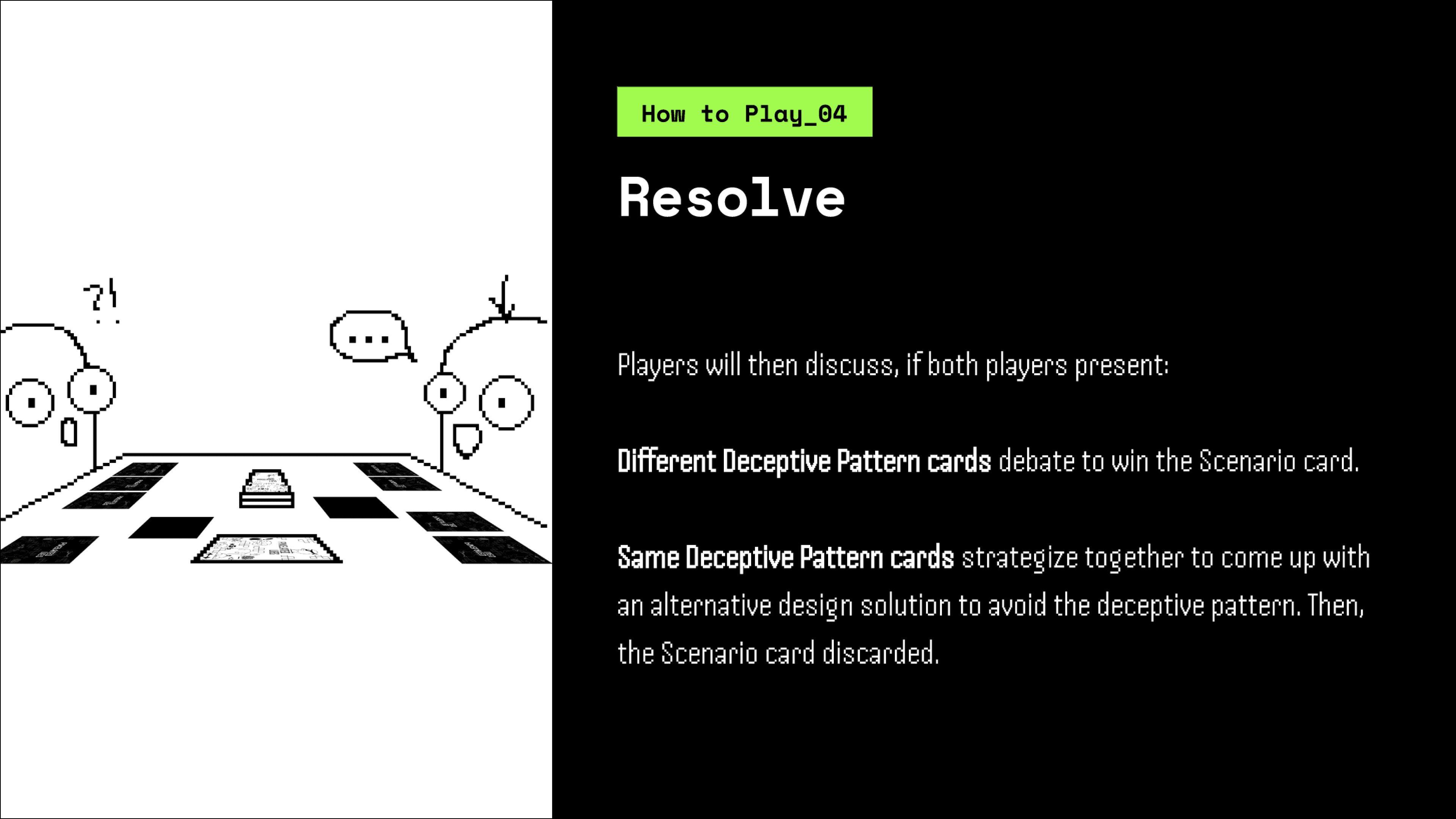
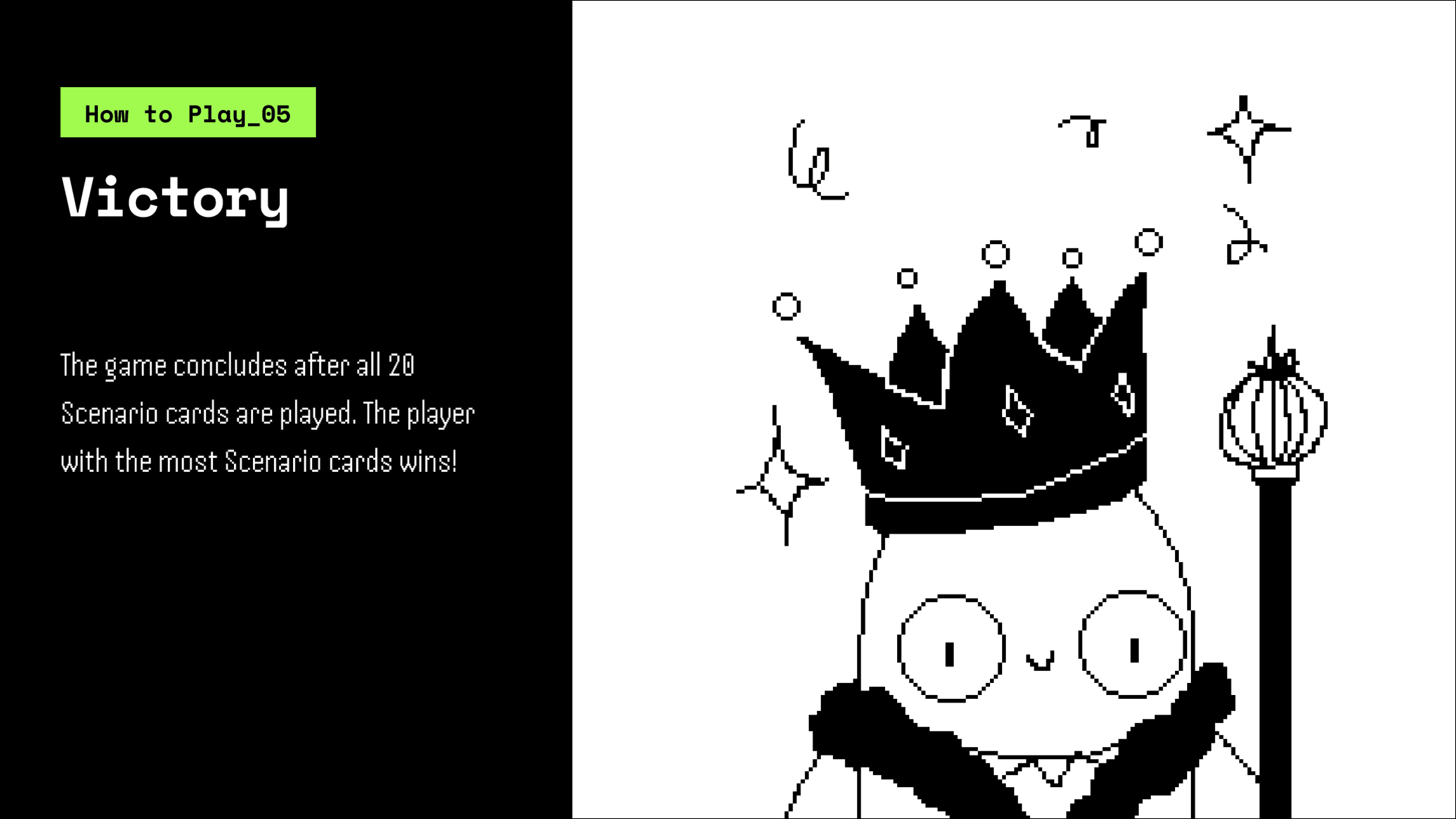
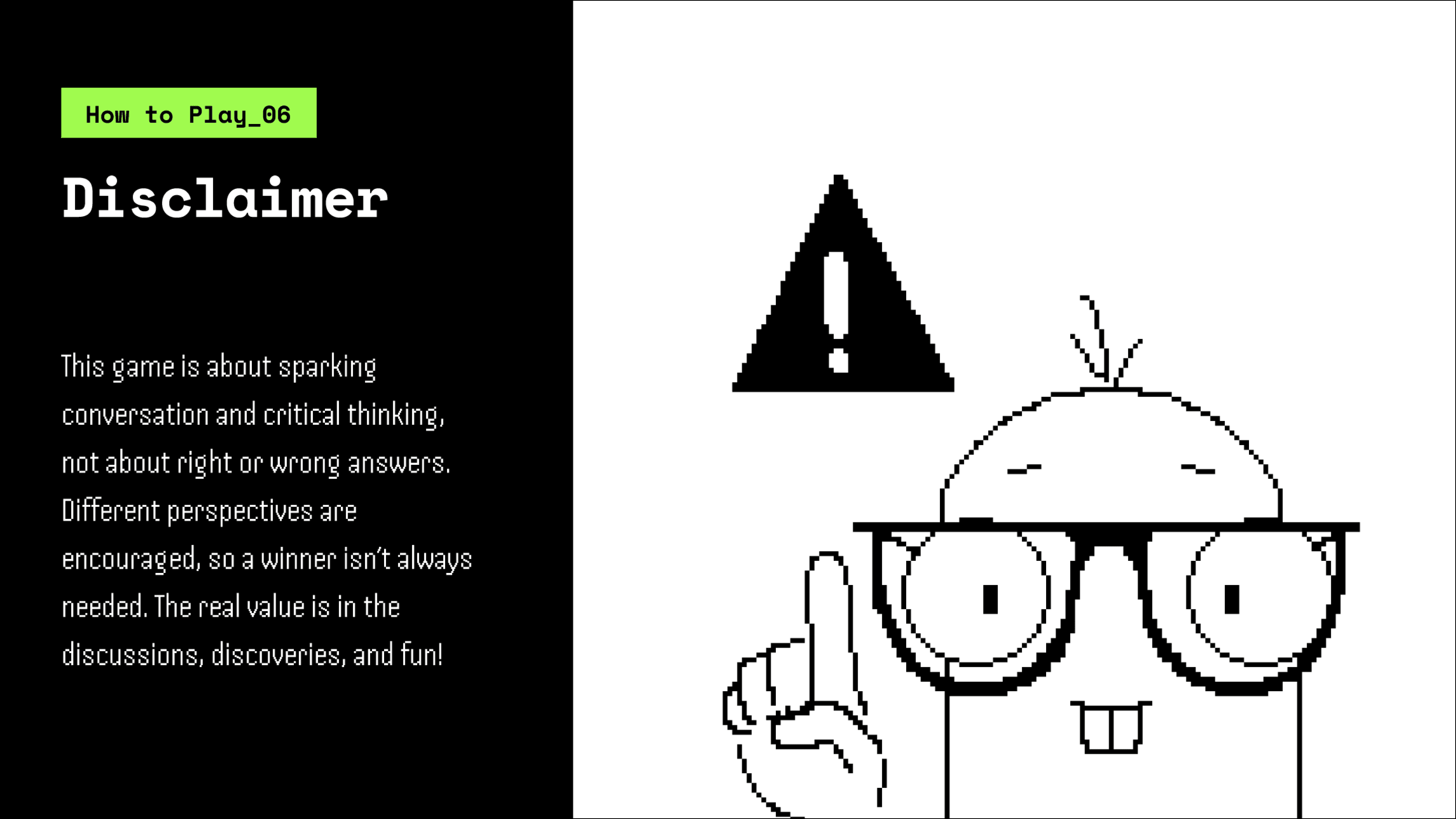
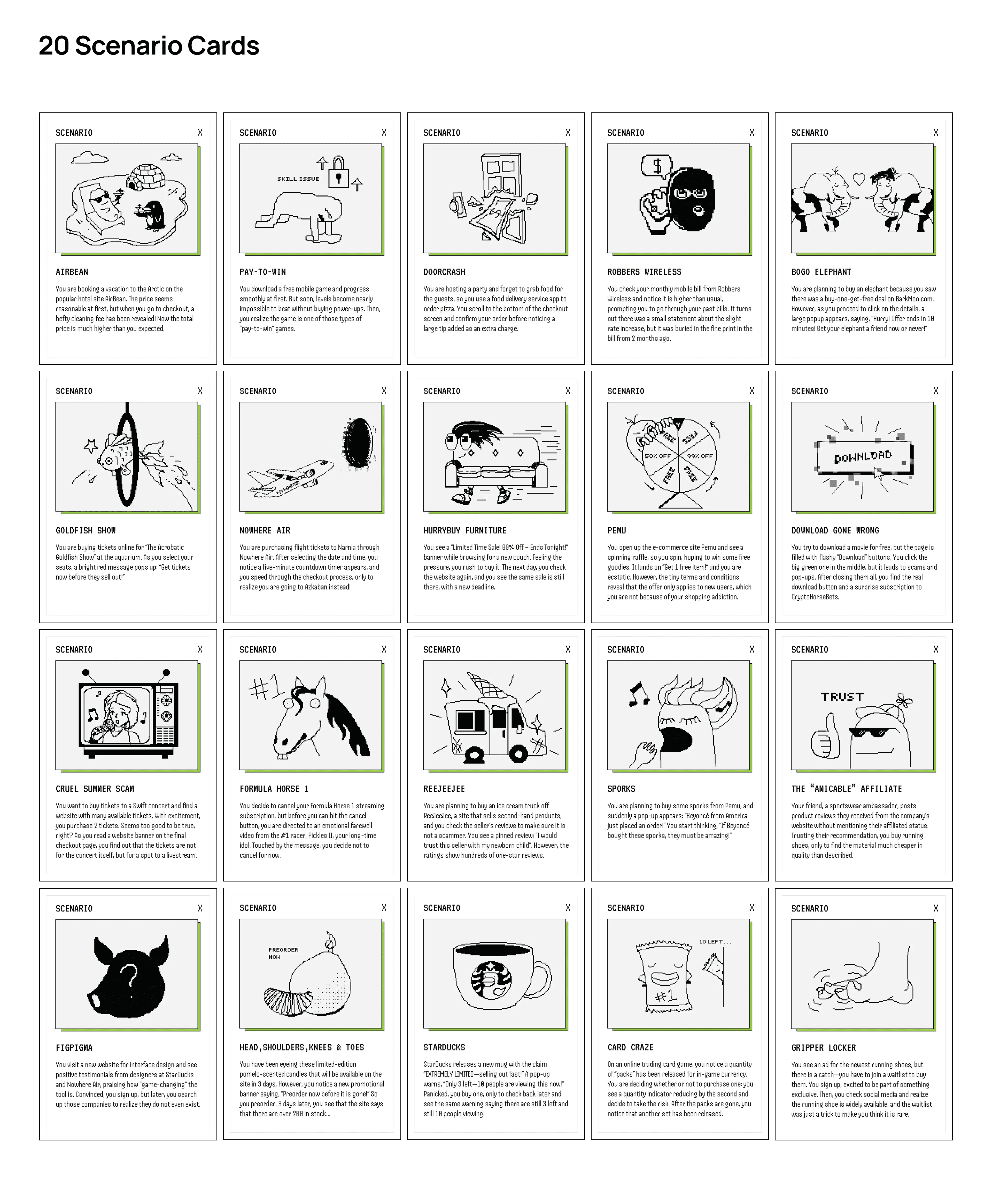
Final Screens Overview
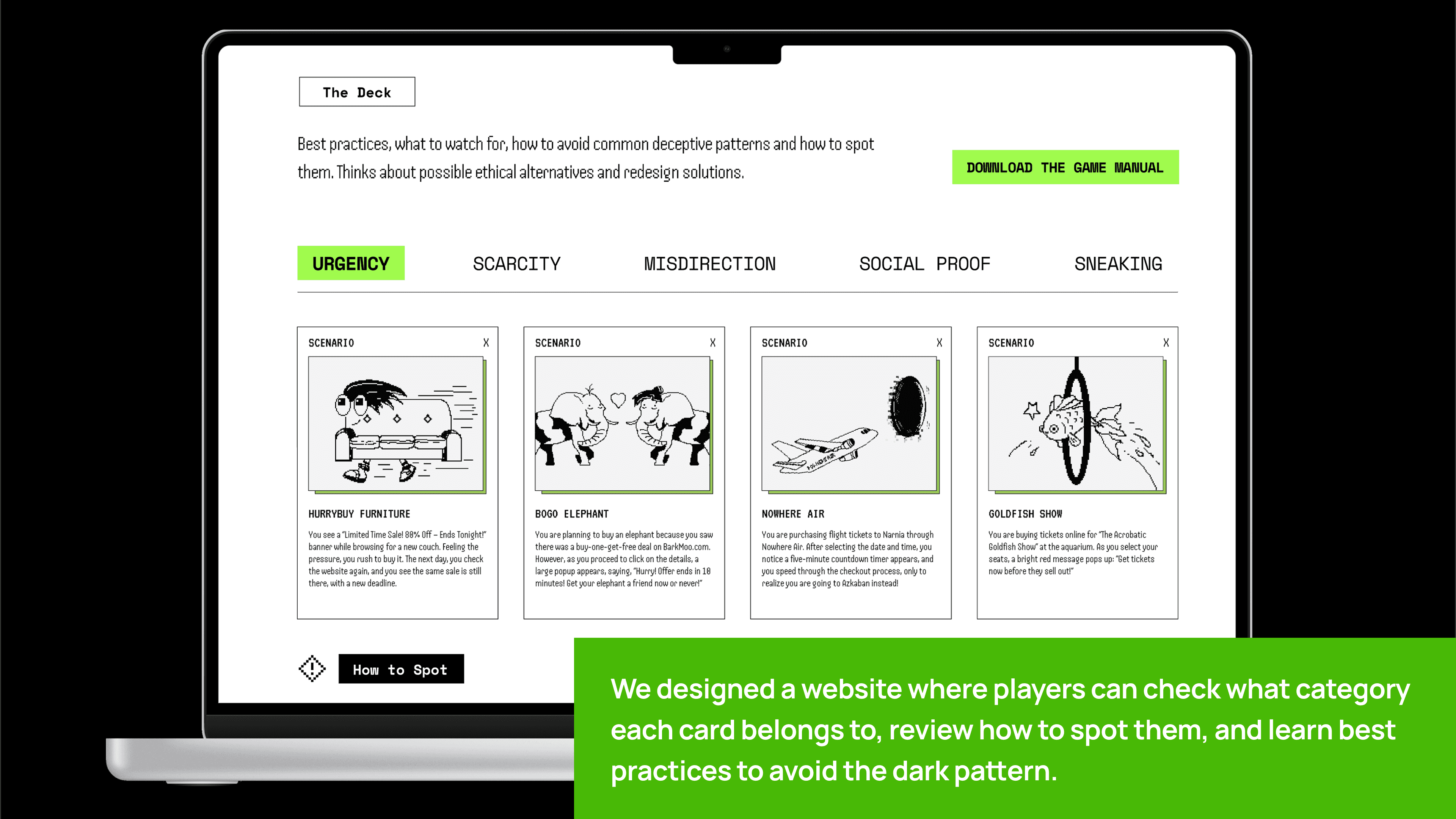
Web Demo
Web Demo
Next Steps
Next Steps
Our next steps are focused on refining the gameplay by further integrating more cards (both scenario and types of deceptive patterns) and bringing the physical experience into digital forms to make it more of an immersive experience and accessible to all users.
Our next steps are focused on refining the gameplay by further integrating more cards (both scenario and types of deceptive patterns).
We want to bringing the physical experience into digital forms to make it more of an immersive experience and accessible to all users.
Incorporate single-player mode with the help of an AI Bot to assist players throughout the gameplay by prompting questions, and generating new scenarios that are up-to-date to current trends.
Incorporate single-player mode with the help of an AI Bot to assist players throughout the gameplay by prompting questions, and generating new scenarios that are up-to-date to current trends.
Branding
Branding
Why Pixelated Lies?
The brand name was inspired by how pixels form the building blocks of what we see and interact with on screens.
User experiences are shaped by how these pixels are designed and how they interact. However, when these patterns are misused, they create “lies” hidden in plain sight.
The brand name was inspired by how pixels form the building blocks of what we see and interact with on screens.
User experiences are shaped by how these pixels are designed and how they interact. However, when these patterns are misused, they create “lies” hidden in plain sight.
Pixelated Lies' branding draws inspiration from the retro aesthetic of early computer systems. This approach is reflected in the pixelated style of the illustrations and the overall card design.
From the colours to the layouts, bright green hues and playful illustrations were used to draw players in and create an engaging experience.
The app’s colours were chosen to create a sense of youthful energy and excitement.
We wanted the user to feel energetic and optimistic when signing up for a program, and create a feeling of anticipation.
- Orange (Movement)
- Green (Health)
- Yellow (Optimism and Energy)
- Purple (Inspiration)
The app’s colours were chosen to create a sense of youthful energy and excitement.
We wanted the user to feel energetic and optimistic when signing up for a program, and create a feeling of anticipation.
- Orange (Movement)
- Green (Health)
- Yellow (Optimism and Energy)
- Purple (Inspiration)
Outcome
Outcome
The Impact
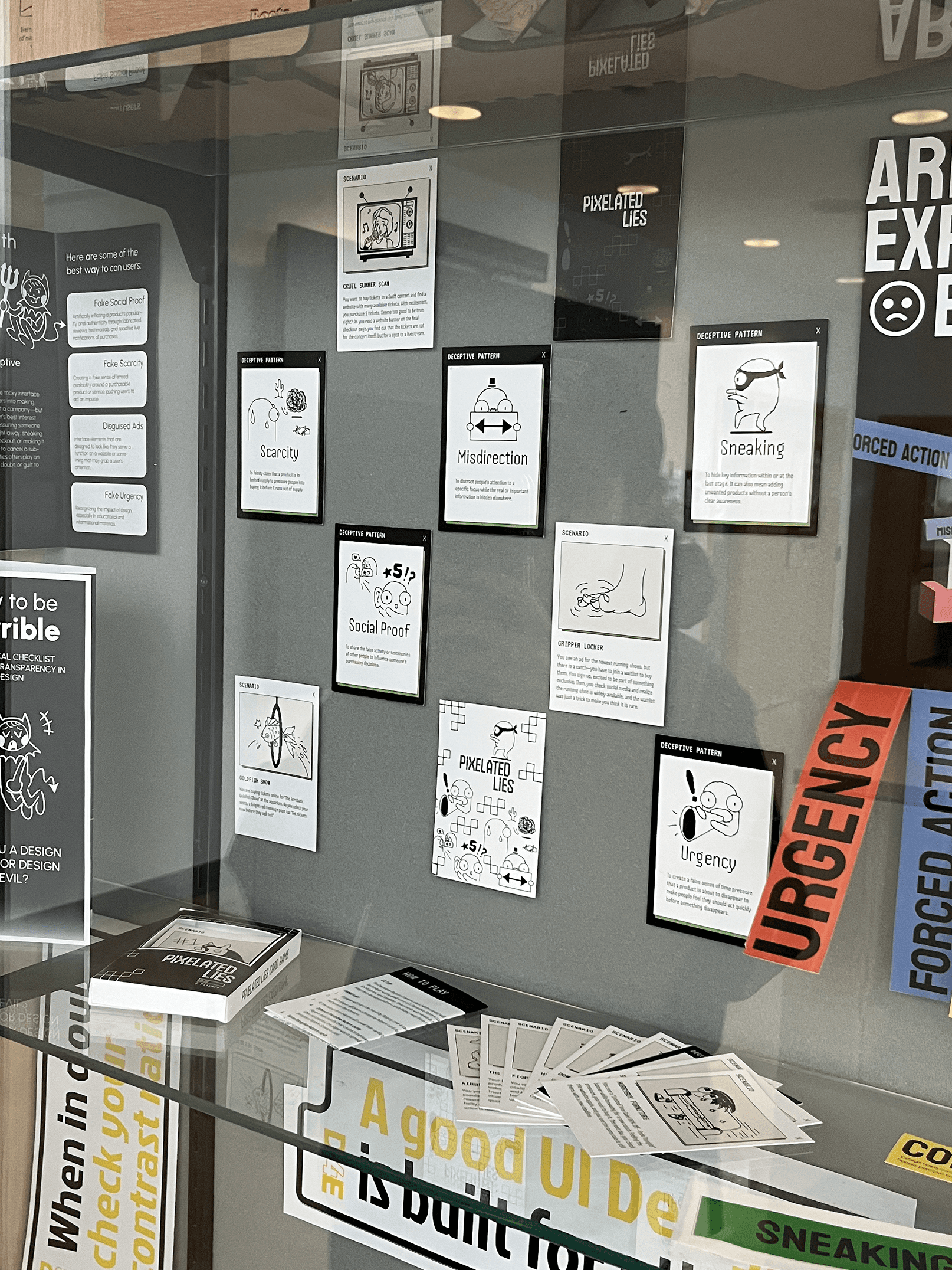
After a month of hard work, our project was chosen to be featured in York University's Design display case.
After a month of hard work, our project was chosen to be featured in York University's Design display case.
This recognition was a significant moment for us; it not only validated our approach but also gave us the honour of promoting ethical design practices and sparking conversations among design students and faculty.
This recognition was a significant moment for us; it not only validated our approach but also gave us the honour of promoting ethical design practices and sparking conversations among design students and faculty.
TAKEAWAYS
TAKEAWAYS
TAKEAWAYS
Reflection
Reflection
Pixelated Lies taught me how to apply gamification to enhance user experience. By transforming the complex topic of deceptive patterns into an engaging card game, I got to learn how to find creative ways to share knowledge and foster a more enjoyable learning process.
Pixelated Lies taught me how to apply gamification to enhance user experience. By transforming the complex topic of deceptive patterns into an engaging card game, I got to learn how to find creative ways to share knowledge and foster a more enjoyable learning process.
This project was also an empowering experience for me. It was an honour to work with a team that shared the same commitment to designing with purpose. Together, we created a tool that not only teaches users to spot manipulative tactics but also empowers us and others to embrace an ethical design mindset.
This project was also an empowering experience for me. It was an honour to work with a team that shared the same commitment to designing with purpose. Together, we created a tool that not only teaches users to spot manipulative tactics but also empowers us and others to embrace an ethical design mindset.
What did I learn?
Flexibility
Flexibility
Learned to recognize and adapt to evolving problems and solutions. Recognizing that initial ideas may not be the final, or even the best, solution.
Learned to recognize and adapt to evolving problems and solutions. Recognizing that initial ideas may not be the final, or even the best, solution.
Open Mindset
Open Mindset
Learned to keep an open mindset to keep exploring and not to get attached to one idea or solution.
Learned to keep an open mindset to keep exploring and not to get attached to one idea or solution.
Leadership & Team Work
Leadership & Team Work
Learned to be an effective team player. Took initiative in organizing discussions and setting actionable goals, while providing constructive feedback.
Learned to be an effective team player. Took initiative in organizing discussions and setting actionable goals, while providing constructive feedback.
Challenges
This project taught me valuable lessons through the different challenges that presented during design thinking process and iteration of the product.
This project taught me valuable lessons through the different challenges that presented during design thinking process and iteration of the product.
Scalability
Scalability
The current format of the game limits its potential to reach to a wider audience. The physical card game, while effective for a small group, it could expand onto digital platforms to make it more accessible for others.
The current format of the game limits its potential to reach to a wider audience. The physical card game, while effective for a small group, it could expand onto digital platforms to make it more accessible for others.
Time Constraints
Time Constraints
The project could have covered more content if the project timeline spanned longer. But this project serves a good foundation for future projects.
The project could have covered more content if the project timeline spanned longer. But this project serves a good foundation for future projects.
Work Division
Work Division
Working with team members who had different areas of expertise, we had to ensure we had clear communication about the work division.
We established a system for regular check-ins and shared our progress and feedback.
Working with team members who had different areas of expertise, we had to ensure we had clear communication about the work division.
We established a system for regular check-ins and shared our progress and feedback.